
Character Dossier
Sir Victor Fan Wei-Min

Sir Victor Fan Wei-Min is widely regarded as the most influential businessman on Paradise Island and the island’s wealthiest individual. At the age of seventy-six, he is rarely seen without his signature three-piece suit, often complemented by an elegant neck scarf. His neatly combed white hair, full white beard, and gold-rimmed spectacles give him the appearance of a refined gentleman. Yet behind his calm and approachable demeanor lies a reputation for discipline, precision, and decisive judgment.
Sir Victor is the founder of the Yihan Foundation, Chairman of the Victorium Group, and Chairman of The Grand Victorium Hotel. Over decades, he has built a vast business network spanning finance, hospitality, art investment, and international strategic funds. Unlike many corporate magnates, he avoids public attention, believing that true influence is measured not by visibility, but by the stability and longevity of one's impact.
Beyond the business world, he is also a renowned collector of fine jewelry and master paintings, with a private collection that bridges European classical art and modern Asian masterpieces. To Sir Victor, art is not merely an asset, but a legacy of civilization.
Those who know him well often describe his voice as calm and gentle. He speaks softly and listens carefully. Yet when critical moments arrive, his decisions are swift and unwavering. He believes that order is built through discipline, not fear.
When instability threatened Paradise Island, it was Sir Victor who quietly funded the infrastructure and financial framework that allowed stability to return.
To the public, he appears as a philanthropist and a respected business leader.
But within the deeper architecture of power,
Sir Victor Fan Wei-Min is the kind of man who builds the harbor long before the storm arrives.
Hung Tsung-fu

Hung Tsung-fu, forty-eight years old, is a newly recruited specialist within MCS and the former Deputy Commander of the Bomb Disposal and Explosive Ordnance Unit at Xin Cheng Bay Coast Police Division.
He is not a man who commands attention the moment he enters a room. Yet when he steps into a briefing chamber, the atmosphere changes. Conversations slow. The room grows quieter. It is the kind of presence shaped by years of standing within meters of devices designed to kill.
Hung received advanced training at the UAS (United Advanced Systems) Explosive Ordnance Training Facility, where he specialized in the structural analysis of improvised and military-grade explosive systems. Over the years, he has developed an extensive understanding of KARAM’s bomb architecture, particularly their modular detonation chains and layered trigger mechanisms.
Within MCS, Hung leads the development of counter-explosive technologies and signal disruption strategies. What he brings to the organization is not merely technical skill, but a disciplined methodology for working under extreme risk.
The counter-terror robot he introduced is capable of analyzing chemical reactions in the surrounding air before approaching a device, predicting potential detonator responses.
The strike drone system he designed can identify and disrupt remote detonation signals within fifteen seconds.
To Hung Tsung-fu, explosions are not chaos.
They are engineering.
If you understand every component, you understand how destruction is assembled.
He speaks little during strategic meetings, rarely offering long explanations. But when debates spiral and uncertainty spreads, he usually says a single sentence—and the entire room listens.
He once said:
“Fear is not the enemy.
Fear is a discipline.”
Within the operational structure of MCS, Hung is rarely the first man through the door.
But when a bomb is discovered,
everyone waits for him.
Because in that moment,
he is the one who decides whether time continues to count down—or begins again.
KARAM
(Khalifat Al-Ra’d Al-Muqawimah)
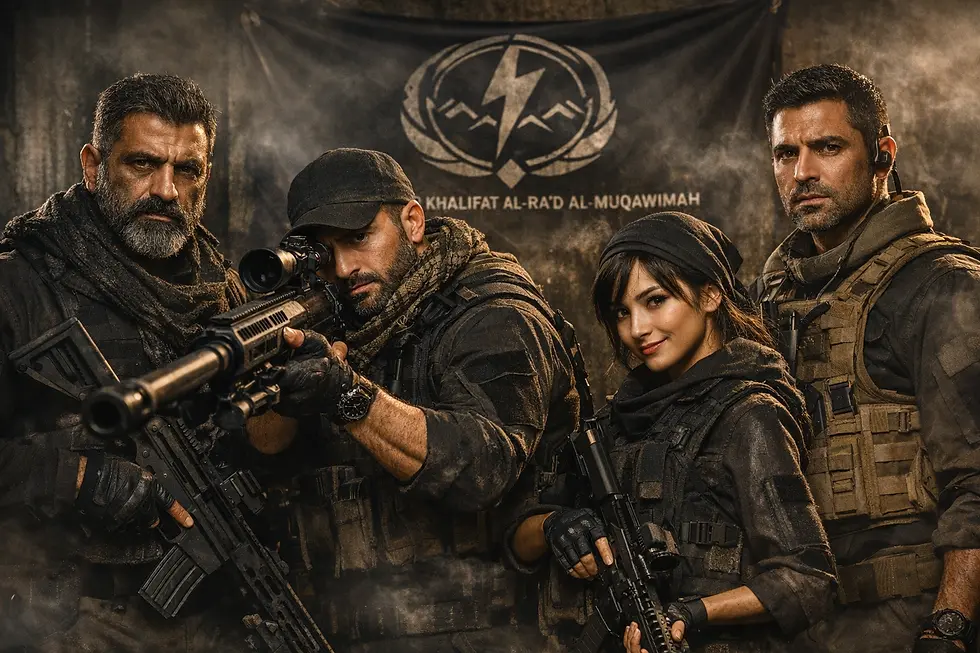
KARAM is a transnational extremist network organization operating under the guise of radical religious ideology. Publicly, it claims to defend the oppressed; in reality, it engages in kidnapping, targeted assassinations, bombing attacks, suicide operations, financial fraud, money laundering, and illicit arms and encrypted fund transfers. “Ra’d” (Thunder) symbolizes its doctrine—strike like thunder, withdraw without a trace, and leave fear as the echo. The organization is highly structured, comprising strategic planners, technical specialists, financial operators, and sleeper logistics personnel. Its operations are rarely improvised; every action is meticulously engineered.
Muhammad Badr Al-Satiqan
45, holds a PhD in Chemical Engineering and graduated from the Urelius Institute of Technology (UIT). He possesses a pilot’s license and previously underwent Black Star ground combat training, where he was a contemporary of Richard Fair and Eagle Eye. During the war, coalition forces bombed the northern city district; when he returned home, only the walls and photographs remained—his family was gone. From then on, he abandoned his surname and renamed himself Muhammad, joining KARAM. Cold and taciturn, rational yet ruthless, he specializes in designing multi-trigger, highly sophisticated explosive devices that are difficult to dismantle. He believes in order and retribution, plans with patience, rarely shows anger, yet is extremely dangerous.
Saeed Hanifnejad
55, is an assassination specialist from KARAM’s special forces. With a full beard and a steady build, he moves without sound, his actions shadowlike and seamless. Solitary and taciturn by nature, he prefers isolation, trusting neither emotion nor people—only distance and angles. His observational skills are almost ruthless; within three seconds, he can assess exits, cover, and the most lethal trajectory. His gaze is sharp and icy, never hesitant, never leaving room for mercy. His style is defined by extreme precision—advance reconnaissance, repeated simulations, ensuring a single decisive strike with no margin for error. He does not seek chaos; he seeks completion of the mission. The kind of man who has already planned his escape before he makes his move.
Mossad Jabbar
35, serves as KARAM’s operations planner and long-range marksman. A graduate of Hasalam College, he possesses a methodical mind, capable of breaking complex missions into precise, executable phases. Each morning begins with a single espresso—his ritual for entering a state of disciplined calm. He favors lightweight tactical gear, eliminating unnecessary burden to maximize mobility and efficiency.
He embodies the classic traits of a sniper: patience, steadiness, and unwavering focus. Capable of remaining motionless for extended periods, he studies wind, terrain, and timing before committing to action. His mind is cold; his hands even colder. By the time he pulls the trigger, every possible variable has already been rehearsed in his head.
As an operations planner, he designs vantage points, escape routes, and contingency layers. He does not rely on adrenaline or ideology in the moment of execution. For him, a mission is not passion—it is a calculation. Precision is not preference; it is discipline.
Yuliana Mamu
28, is the leader of KARAM’s suicide operations unit and the wife of Mossad. Petite and slender in appearance, she seems easy to overlook, yet her strength is concentrated and explosively swift. Her movements are light like a leopard’s—entering and retreating without leaving a trace. In a crowd, she blends in naturally; in the shadows, she disappears in an instant.
When she smiles, the corners of her eyes lift slightly, the curve sharp as a blade hidden in velvet. It is not a gentle smile, but one of control over the situation. She specializes in close-range infiltration and high-risk missions, possessing an acute sense of space and timing, able to maintain clarity amid chaos. As a leader, she does not command with volume, but with her gaze and subtle hand signals—her movements clean and precise.
Her focus on missions borders on obsession, with zero tolerance for error. She rehearses repeatedly beforehand and never hesitates once action begins. She believes sacrifice is a choice, not an impulse. Calm, decisive, and explosively powerful—she is the kind of person who can still smile in the final second.
Ayman Adel
codename “Mirage,” is an intelligence operative and sleeper asset for KARAM on Paradise Island. Recruited not for physical strength but for patience and discipline, he operates as a strategist rather than a frontline combatant. Under a forged identity as a logistics coordinator, he gained access to shipping routes, infrastructure layouts, and port security systems — embedding himself quietly within the island’s operational framework.
For months, he made no visible move. That invisibility was his strategy.
Ayman believes in positioning over martyrdom. He destabilizes systems by studying human behavior before targeting structures. Through emotional mapping, he identifies fatigue, resentment, insecurity, and ambition — aligning rather than threatening. He communicates sparingly, avoids digital exposure, and relies on memory over devices.
Calm, deliberate, and ideologically detached, Ayman does not act out of hatred but out of calculation. He sees power structures as fragile systems that require pressure to reveal their weaknesses. He seeks leverage, not chaos.
His philosophy is simple: noise attracts attention, but silence reshapes history.
Burhanuddin Hekmatyar
Codename “Architect,” is KARAM’s bomb specialist and ordnance engineer operating as a sleeper asset within Paradise Island’s industrial sector. Afghan-born and forged into survival by war, he grew up in an environment where explosions were commonplace. By nineteen, he could dismantle artillery shells blindfolded; by twenty-four, he was recruited into insurgent engineering cells. Over time, ideology faded — precision remained.
He joined KARAM not out of belief, but for mastery. Under the cover of a mechanical maintenance supervisor at a port facility, he gained access to industrial materials, fuel depots, and shipping infrastructure.
Burhanuddin approaches explosives mathematically. He constructs devices like equations — calculating pressure ratios, timing accuracy, and signal redundancy. He avoids spectacle and focuses on structural disruption. His designs are modular: trigger, detonator, payload, override — transported separately and assembled shortly before deployment.
He prefers remote detonation and avoids suicide operations, maintaining full control over his devices. Calm, observant, and emotionally restrained, he sees himself not as a killer, but as an engineer revealing structural weakness.
To him, explosions are not chaos — they are proof of fragile foundations.
The International Counter-Financial Intelligence Directorate (ICFID)

Before algorithms begin ranking human value,
humanity must first learn how to rank lies.
The International Counter-Financial Intelligence Directorate (ICFID) has never been a high-profile organization.
It wears no tactical vests, stages no assault footage, and rarely appears in headlines.
But on the true modern battlefield—
capital flows, public opinion, psychological warfare—
it is more lethal than any armed force.
Lin Yi-Chen
Position: Director of Strategic Financial Analytics
Specialties: Cross-border fund tracking, micro-transaction matrix modeling, underground financial network analysis
Lin Yi-Chen is the kind of person so quiet he is almost overlooked.
He does not speak much, but every sentence sounds precisely calculated. To him, finance is not about numbers—it is about behavioral trajectories. From a seemingly harmless micro-transfer, he can detect the breathing rhythm of an entire underground chain behind it.
The “Micro-Flow Matrix” he built does not simply track large transactions. It analyzes fragmentation. Fraud syndicates excel at breaking money flows into thousands of small transfers to evade regulation. Lin Yi-Chen specializes in studying this kind of “fragmented behavior.”
He once said:
“True black money isn’t defined by how much there is, but by its pattern.”
His personality is exceptionally calm, untouched by emotion. He does not fear risk—he calculates probability. He does not chase criminals; he allows them to expose their own mathematical flaws.
Within the IFCC, he is the core of the financial battlefield.
Sarah Morrison
Position: Senior Legal Operations Counsel
Specialties: Cross-border asset freezing, judicial coordination, application of international sanctions frameworks
Sarah is the person in IFCC who least resembles a warrior.
She wears tailored suits and high heels. She speaks gently and smiles with composure. Yet within forty-eight hours, she can freeze the grey assets of a transnational fraud syndicate across three jurisdictions.
She understands every legal loophole—and more importantly, how to close financial pathways swiftly within the bounds of the law. Her battlefield is statutes, treaties, and the narrow seams of international judicial cooperation.
Her strength is not force.
It is precision.
She once said:
“You don’t need to destroy them. You only need to make it impossible for them to move.”
Sarah is rational, but not cold. She knows that behind every frozen account there may be innocent parties involved, which is why her standards for evidence are uncompromisingly high.
She represents the power of institutions.
When IFCC requires both legitimacy and speed, she is the key.
Park Sung-Hoon
Position: Chief Digital Infiltration Analyst
Specialties: Dark web infiltration, public opinion dynamics intervention, counter-narrative implantation
Park Sung-Hoon’s battlefield has no borders.
He spends long hours inside the dark web and grey-market forums, capable of posing as three different identities in three different languages at the same time. He does not merely infiltrate groups—he infiltrates emotion.
What he studies is “narrative.”
He knows that if a rumor is not rewritten within seven minutes, it will begin to grow roots.
His strategy is not suppression, but redirection. When extremist groups attempt to manufacture distrust, he implants stabilizing narratives at critical nodes—not to persuade, but to make people “doubt the doubt.”
His personality is exceptionally calm, with a trace of cynical detachment. He once told me:
“There is no truth on the internet—only who speaks first.”
Within the IFCC, he stands at the front line of the war of ideas.
Wu Ying-Hsuan
Position: Behavioral Narrative Architect
Specialties: Contextual structure analysis, emotional node identification, group psychology forecasting
Wu Ying-Hsuan’s work appears the least conspicuous—yet it is the most critical.
She does not merely analyze words. She studies tone, rhythm, pauses, and repetition patterns. From a single post, she can identify “emotional manipulation nodes” and predict which phrasing will ignite collective anxiety.
She is neither a hacker nor a legal expert. She studies people.
She often says:
“Crowds are not persuaded. They are carried away by emotion.”
Her personality is composed and observant. Unlike Lin Yi-Chen, she does not believe in pure mathematical models. She believes language leaves psychological traces.
When KARAM attempts to implant doubt through narrative, she is the one who dismantles the structure of the story.
Security Mobile Unit (SMU)
Under MCS Tactical Command

The Security Mobile Unit is the most flexible and precise tactical support division within the MCS system.
To the outside world, they are elite protection specialists.
They are responsible for safeguarding national leaders, political figures, corporate magnates, celebrities, and international icons.
Where they appear, it means risk has been assessed, threats have been anticipated, and evacuation routes have already been designed.
But that is only the surface.
Their primary mission—
has always been to support the Raptor Special Force,
to align with MCS’s overall tactical deployment,
and to execute high-risk operations under the command of Eagle Eye.
Structure
Total Personnel: 48
Four Tactical Units
Twelve operators per team
Each team’s standard tactical configuration includes:
-
2 Snipers (long-range precision suppression and battlefield overwatch)
-
2 Drone Operators (aerial surveillance, tactical reconnaissance, real-time data relay)
-
8 Frontline Assault Operators (close-quarters suppression, breach, protection, and control)
This is not a conventional security unit.
This is a mobile tactical strike team.
Equipment & Mobility
Every operator is equipped with:
-
Full special-police-grade tactical gear
-
Ballistic armor systems
-
Modular assault rifles
-
Night vision and tactical communications systems
Mobility assets include:
-
8 Tactical Hummer vehicles (all-terrain rapid deployment)
-
8 Weaponized drones (aerial fire support and precision targeting capability)
All units are capable of completing, within extremely short response times:
-
Urban assault operations
-
Coastal rapid deployment
-
High-rise building lockdowns
-
Hostage rescue support
-
VIP extraction missions
Role
The Security Mobile Unit is not merely a protective force.
They are a tactical interface.
When Raptor requires additional suppression.
When MCS needs a second wave of firepower.
When Eagle Eye demands ground extension.
SMU deploys.
They are the mobile extension of order.
And the second blade on the battlefield.
Mobile Defence Battatlion (MDB)

Island Defence. Operational Continuity. Absolute Readiness.
The Mobile Defence Battalion (MDB) is the permanent security and operational backbone of the island base. Unlike rapid assault units that deploy outward, MDB holds the ground. They are responsible for island defence, self-protection, security enforcement, and operational sustainability.
If the Tactical Teams are the blade,
MDB is the shield.
Core Characteristics
1. Multi-Role Operational Force
MDB is not a conventional military battalion. It integrates defence, security enforcement, infrastructure protection, and base operations into a single coordinated structure.
2. Persistent Readiness
24/7 alert posture. Rotational rapid-response teams remain deployment-ready within minutes.
3. Integrated Command Discipline
Direct coordination with MCS Tactical Command, Raptor Special Force, and White Knight system monitoring (human-authorized). No autonomous override authority.
4. Controlled Aggression
They are defensive by doctrine, decisive by execution.
Job Scope
Island Defence
-
Perimeter security across land, sea, and air sectors
-
Coastal patrol operations with armed fast boats
-
Radar monitoring and early threat detection
-
Missile defence system oversight
-
Anti-drone interception and airspace control
Internal Security & Self-Protection
-
Base access control and layered security protocols
-
Counter-infiltration patrols
-
High-risk facility lockdown procedures
-
Crisis containment and urban defensive response
Operational & Infrastructure Management
-
Airstrip and aircraft ground security
-
Fuel, logistics, and ammunition storage oversight
-
Communications grid protection
-
Power, water, and data infrastructure safeguarding
Rapid Reinforcement Support
-
Secondary tactical reinforcement for Raptor Special Force
-
Defensive perimeter establishment during outbound MCS missions
-
Strategic fallback and containment operations
Specialties
Advanced Surveillance Integration
Real-time radar, maritime tracking, thermal imaging, and drone reconnaissance management.
Layered Defensive Architecture
Multi-ring defensive grid system:
Outer maritime shield → Air surveillance → Inner base lockdown grid.
Island Warfare Adaptation
Amphibious response capability.
Coastal interdiction.
Rapid terrain adaptation across jungle, runway, and shoreline environments.
Continuity of Command Protection
Ensures the island remains fully operational even during simultaneous external deployments.
Strategic Positioning
MDB does not seek visibility.
They ensure stability.
When MCS deploys outward, MDB ensures the island never becomes vulnerable.
When threats approach the perimeter, MDB is the first to respond—and the last to withdraw.
They are not the strike force.
They are the foundation that makes every strike possible.