LOG 06 — 第三宗绑架
06:20.
The phone rang while I was still inside the Old City CID command room.
Dawn had not fully arrived.
The city was caught between darkness and light.
A strange hour.
The kind of hour when people think nothing is moving.
When in fact, the most important things often are.
I answered.
No greeting.
No briefing.
Only four words.
“We have another one.”
I already knew.
If it had reached me directly, it wasn't routine.
It wasn't random.
“Who?”
A pause.
Then:
“Ken Holmes.”
Across the room, Chang Hsin-Yan looked up.
She hadn't heard the name.
But she saw my expression.
That was enough.
Forty minutes later, I was standing inside the Old City Port Zone.
The wind carried the smell of salt and diesel.
Containers stood in endless rows.
Steel canyons.
Steel walls.
Steel silence.
The entire district was under lockdown.
Customs officers.
Port Authority personnel.
Police.
Security contractors.
Everyone moving.
Nobody understanding.
Because this time the victim wasn't a wealthy heir.
Or a cybersecurity specialist.
This time it was transport.
Infrastructure.
Flow.
Ken Holmes.
A man connected to Paradise Island's MRT and bus manufacturing contracts.
A man whose disappearance reached beyond money.
Beyond family.
Beyond business.
As I stepped out of the vehicle, three names aligned inside my head.
Alan Ho.
Sun Yi.
Ken Holmes.
Three victims.
Three industries.
And one growing pattern.
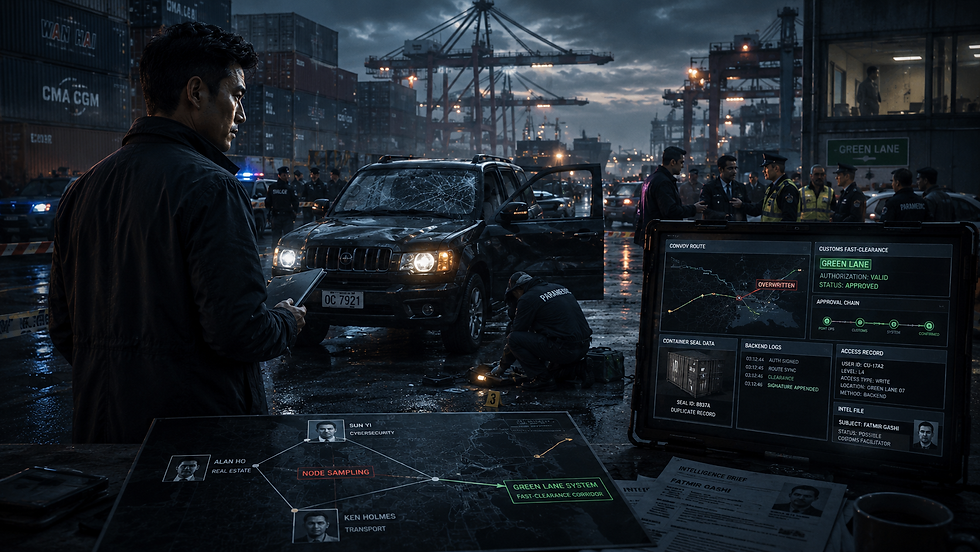
The convoy's GPS had remained normal.
Normal speed.
Normal route.
Normal communication.
Then suddenly—
the route disappeared.
Not the vehicles.
The path.
The records showed movement.
The system showed activity.
The convoy supposedly continued to travel.
Yet the actual route no longer existed.
It had been overwritten.
Legally overwritten.
As if someone had erased a road from reality.
A technician stood beside me.
"We've never seen this before."
I nodded.
"That's because this wasn't an intrusion."
He frowned.
"What do you mean?"
"It wasn't hacked."
I pointed at the screen.
"It was used."
The room became very quiet.
Just like Alexis Tech.
Someone had access.
Or someone had access to the people who controlled access.
Hours later we found one of the escort vehicles at a disused maintenance station.
The doors were open.
The windshield shattered.
Damage visible.
But no evidence of a major firefight.
The scene felt familiar.
Too controlled.
Too measured.
The exact amount of violence necessary.
No more.
No less.
One guard was already dead.
The second was barely alive.
I crouched beside him.
His breathing rattled.
His fingers grabbed my sleeve with surprising strength.
I leaned closer.
"Who took him?"
His lips moved.
Blood touched the corner of his mouth.
"Green..."
I lowered my head.
"What?"
"Green..."
His chest tightened.
Then finally—
"Lane..."
His hand fell away.
The monitor emitted a long, flat tone.
No one spoke.
Because every person there understood.
Those two words mattered.
Green Lane.
Hours later the audit began producing results.
A customs fast-clearance corridor.
Anomalous authorization records.
A duplicated digital container seal.
Backend approval signatures.
Timestamp inconsistencies.
Incomplete validation chains.
And the most disturbing part—
everything appeared legal.
Perfectly legal.
I stared at the documents.
Then smiled.
A tired smile.
One investigator looked confused.
"What is it?"
I set the file down.
"If every step is legal..."
I looked up.
"...then the problem isn't the system."
The room waited.
"It's the people."
That afternoon the arguments began.
Customs blamed Port Authority.
Port Authority blamed contractors.
Contractors blamed system vendors.
Everyone blamed process.
Nobody wanted responsibility.
Because responsibility meant exposure.
And exposure meant consequences.
Ken Holmes was already generating international attention.
Paradise Island PTAU had entered the picture.
Diplomatic channels were asking questions.
The pressure was building.
But the answer was becoming clearer.
Chang stood before the board.
She wrote three names.
Alan Ho.
Sun Yi.
Ken Holmes.
Then she drew three lines.
Real Estate.
Cybersecurity.
Transport.
She stopped.
Looked at me.
I looked back.
No discussion necessary.
We had arrived at the same place.
Nodes.
Not people.
Nodes.
High-value strategic nodes.
Capital.
Technology.
Movement.
The city's connective tissue.
Chang spoke first.
"This isn't random."
I finished the thought.
"It's node sampling."
The room went silent.
Because those two words changed everything.
The victims were no longer individuals.
They were measurements.
Selections.
Tests.
Pieces of a larger evaluation process.
That evening we officially elevated Green Lane to a primary investigative priority.
The insider theory was no longer theory.
Someone inside the system was opening doors.
Someone inside the system was clearing routes.
Someone inside the system was helping.
And behind that person—
there was something bigger.
Something organized.
Something experienced.
Something that had done this before.
Near midnight, an intelligence brief arrived on my desk.
Thin.
Only a few pages.
But the first page contained a name.
A name I stared at longer than I expected.
Fatmir Gashi.
Beneath it:
Possible customs facilitator.
That was all.
But I knew we had touched something real.
Something hidden.
Something dangerous.
And somewhere beyond the port.
Beyond the sea.
Beyond our visibility.
People were waiting.
Waiting for cargo.
Waiting for information.
Waiting for transactions.
Waiting for the next phase.
At that moment, I didn't yet know the name of the organization behind it all.
I didn't know it would eventually lead us to sea routes, mountain strongholds, and a syndicate called Wing of the Vulture.
But I knew one thing.
Three kidnappings were no longer three kidnappings.
They were becoming a face.
And that face—
was finally beginning to emerge from the dark.